What an Aesthetic Device Really Costs to Own in 2026 (And Why the Full Number Still Works)
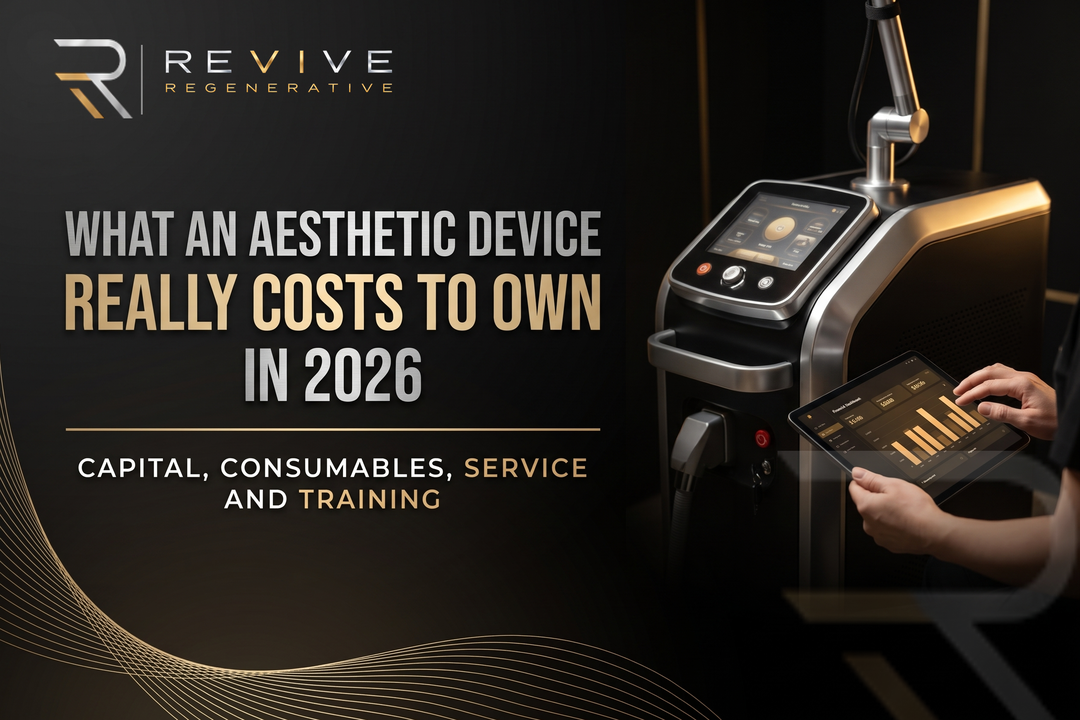
Ask most device companies what their platform costs and you will get one number. That number is the least useful figure in the entire decision.
It is not that the capital price is misleading. It is that it answers a question you are not really asking. What you actually need to know is what this device costs to run for five years, because that is the figure that determines your treatment pricing, your margin, and whether the service line is still profitable in year three.
Here is the good news, and it is the reason this article exists: when you build the complete number for a well-chosen aesthetic device, it almost always still works. Energy-based aesthetics has unusually strong unit economics compared to most medical equipment. The full picture is not a warning. It is what lets you commit with confidence, price correctly, and get a lender or a partner to say yes.
Let us build it properly.
The four components of real device cost
Total cost of ownership in this category breaks into four parts. Most buyers price the first one carefully and estimate the other three.
1. Capital
The purchase price, which is the part everyone focuses on, and the part that is least likely to surprise you.
What matters here is less the sticker and more the structure. Most practices finance rather than pay cash, which converts a large one-time number into a monthly payment you can test directly against projected treatment revenue. That reframing is the single most useful thing you can do early in the process, because a device that looks expensive as a lump sum often looks obviously sound as a monthly figure against four treatments a week.
Section 179 of the tax code allows qualifying equipment to be deducted in the year it is placed in service rather than depreciated over time, which can meaningfully change the first-year cash picture. Limits and eligibility change annually, so confirm the current year's treatment with your CPA rather than with a device rep, including ours.
2. Consumables
This is the variable that decides your margin, and it varies enormously by modality. It is also the number most often left vague during a sales conversation.
Ask for it in this specific form: what does one treatment cost me in consumables, and how long does each handpiece or applicator last?
Then ask for the price and yield of every item in the chain. Depending on the platform that may include single-use tips or cartridges, cryogen, gel, fibers, cannulas, or treatment solutions. Multiply by your projected monthly volume and you have a real operating cost rather than an impression.
The spread here is wide enough to change which device you buy. Some modalities carry a meaningful per-treatment consumable cost that scales directly with volume. Others, particularly Q-switched and ablative laser platforms, have essentially no per-treatment consumable at all once the capital is covered, which is why their margin profile improves as you get busier rather than staying flat.
Neither is good or bad. They are different shapes, and the right shape depends on your pricing and volume.
3. Service and warranty
The cost nobody asks about until year two, when the leverage is gone.
Get these in writing alongside the capital quote:
- Warranty length, and specifically what voids it. Many manufacturers tie coverage to adherence to their maintenance schedule, so a skipped service can mean no coverage at all.
- Stated service response time to your address, and whether a loaner is provided while your unit is down.
- The annual service contract price once the warranty expires. Ask for this before you sign. A company unwilling to quote it now will not be more forthcoming later.
Industry guidance generally suggests at least one year of warranty on a new device, with the option to extend toward five years, which roughly matches the useful service life of many aesthetic platforms.
Downtime is the hidden line item inside this component. A device that is out of service for three weeks in your busiest month costs you far more than the repair.
4. Training, staffing, and ramp
Real costs that rarely appear in a quote.
How many days of on-site clinical training are included, and does the protocol set cover the full range of patients you treat? What does additional training cost when you hire? And critically, how long until the room is actually busy? Most practices take three to six months to reach moderate volume on a newly launched service, which means your first-quarter revenue projection should be deliberately conservative.
Build the ramp into your model rather than discovering it.
A simple way to build your number
You do not need a complicated spreadsheet. Five lines will do it:
- Monthly capital cost. Your financed payment, or the purchase price divided across the years you expect to run it.
- Consumable cost per treatment × projected monthly treatments.
- Monthly service cost. Annual contract divided by twelve, including the post-warranty figure so you are not modeling year one forever.
- Monthly staff cost attributable to the device. Treatment time × loaded hourly rate × volume.
- Monthly revenue. Your realistic price × realistic volume, with a conservative first-quarter ramp.
Line 5 minus lines 1 through 4 is your actual monthly contribution. Run it at a pessimistic volume, a realistic one, and a strong one. If the pessimistic case is survivable and the realistic case is clearly profitable, you have a sound purchase.
Why the full number usually still works
Here is the part that gets lost when people treat cost of ownership as a cautionary exercise.
Aesthetic devices have a better ownership profile than most clinical equipment, for structural reasons:
- Revenue per treatment hour is high. Few things in a medical practice generate what a well-booked energy-based treatment room does per hour of staff time.
- Many of these treatments are series-based. One patient decision frequently produces six, eight, or twelve scheduled visits rather than one, which makes revenue predictable instead of episodic.
- Several modalities are delegable within scope-of-practice rules, so they generate revenue without consuming your physician's or injector's chair time.
- The asset keeps working. A platform with a long supported life and a good service relationship is still producing revenue in year five at a fraction of the original monthly cost, which is when ownership economics become genuinely excellent.
- Multi-indication platforms spread the risk. A device that treats one concern depends on one patient population. A device that treats six is insulated against any single category cooling off.
The practices that struggle with device economics are rarely the ones that priced the device accurately. They are the ones that never built the number at all, set treatment pricing by guesswork, and then discovered their margin was thinner than they assumed.
Knowing the real figure is not what makes a device expensive. It is what makes it bankable.
How to read the Revive lineup on cost of ownership
We would rather give you the complete picture than the flattering half of it. A few honest observations about our own catalog:
- Colormax, our Q-switched Nd:YAG platform, is a strong example of the low-consumable shape. Laser tattoo and pigment work carries essentially no per-treatment product cost, so margin improves as volume climbs. It also covers tattoo removal, pigmented lesions, melasma, rosacea, vascular lesions, acne, and rejuvenation on one capital purchase, which spreads your utilization across several patient populations.
- Avira carries a genuine per-treatment consumable, as all RF microneedling does. That is a real line in your model, and it is offset by a series-based treatment plan and a high price point. We will give you the per-treatment figure, not an impression of it.
- Hydra SH uses tips and solutions, and its open approach to treatment solutions means you are not locked to a single source at a price you cannot control. That flexibility is worth real money over five years.
- Emulsify is surgical equipment with a correspondingly different cost and utilization profile, and it should be modeled against surgical case volume rather than med spa throughput.
Ask us for consumable pricing, handpiece life, warranty terms, and the post-warranty service figure on any platform you are considering. If we are evasive about any of it, you have learned something useful about us.
Frequently asked questions
What is the biggest hidden cost in owning an aesthetic device? Usually the post-warranty service contract, because buyers rarely ask for the price before signing. The second is consumables, which scale directly with volume and determine your margin more than your treatment price does.
How much should I budget for consumables? It depends entirely on modality. Ask for the per-treatment cost and the handpiece or applicator lifespan, then multiply by realistic monthly volume. Q-switched and ablative laser platforms often have near-zero per-treatment consumable cost, while microneedling and hydrodermabrasion carry real per-treatment product expense.
Can skipping maintenance void my warranty? Frequently, yes. Many manufacturers require adherence to a maintenance schedule as a condition of coverage, so a missed service interval can leave you without a warranty exactly when you need one. Read that provision before you sign.
Should I buy outright or finance? Most practices finance, because it converts a capital number into a monthly figure you can test directly against projected treatment revenue. Section 179 treatment may also affect the first-year picture. Confirm the current rules with your CPA.
How long should the warranty be? General guidance suggests at least one year on a new device, with the option to extend toward five years, which approximately matches the useful life of many aesthetic platforms. Equally important is what the warranty actually covers and what voids it.
How long before the device starts contributing? Plan for three to six months to reach moderate volume on a newly launched service. Model your first quarter conservatively and your second and third quarters realistically.
Get the complete number from us
A device company that will only discuss the capital price is making your decision harder, not easier. You should be able to build a five-year model before you commit, and the manufacturer or distributor should be handing you the inputs.
For consumable pricing, handpiece life, warranty terms, service contract figures, and training details on any platform in the Revive device lineup, get in touch with our team. We will give you the inputs to build the model yourself.
This article is intended for licensed medical and aesthetic providers and is not financial, tax, or legal advice. Tax treatment of equipment purchases changes annually and varies by situation; consult your CPA. Device capabilities and terms reflect manufacturer information and should be confirmed in writing before purchase.
Latest insights and trends