Patients Search for the Branded Facial by Name: How to Build a Hydrodermabrasion Service Line in 2026
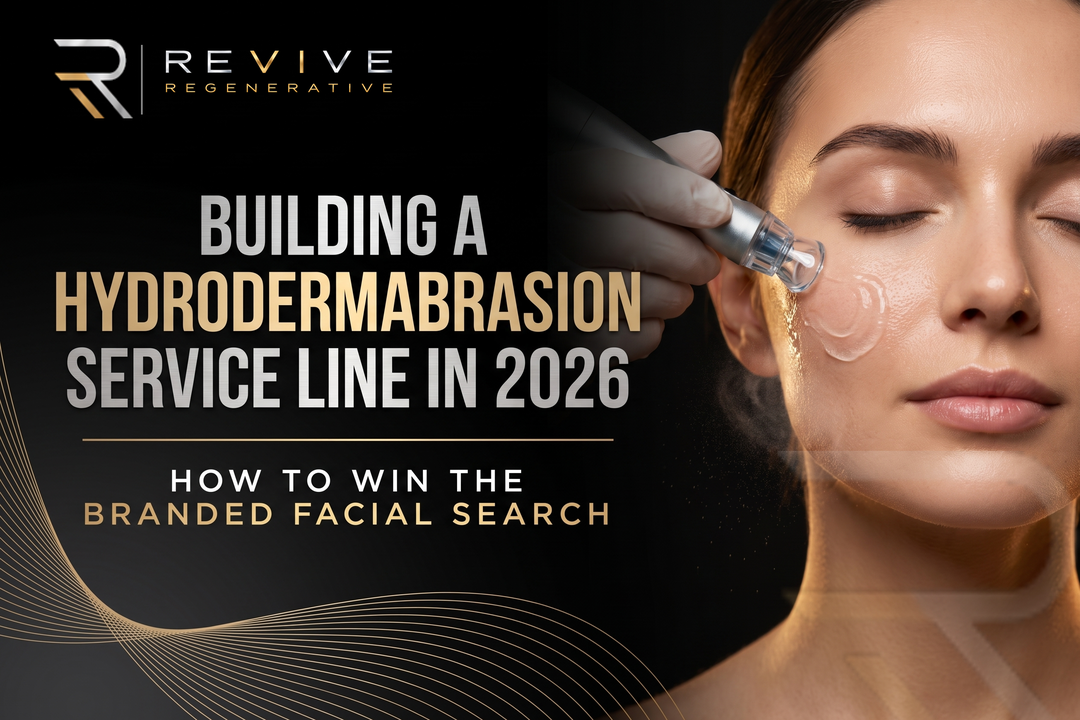
There is a specific pattern almost every med spa owner recognizes. A patient calls and asks for a treatment by brand name. They do not know what technology is inside it, what it does mechanically, or what alternatives exist. They know the name, they have seen it on social, and that is what they want to book.
That branded pull is one of the strongest forces in aesthetics right now, and it puts practices in an awkward position. You can pay a premium to license the brand, or you can build a comparable service line under your own name and compete for the same demand. Both are legitimate strategies. What is not legitimate is blurring the line between them, and that distinction is where a lot of practices quietly get themselves into trouble.
Here is how the hydrodermabrasion category actually works in 2026: the demand data, the economics, the compliance line, and what to look for in a device.
The category is where the volume is
Hydrodermabrasion sits inside the largest service segment in the entire medical spa business.
- The global medical spa market was valued at roughly $24.2 billion in 2025 and is projected to reach about $27.8 billion in 2026, on the way to $78.2 billion by 2033 at a compound annual growth rate near 16 percent.
- Facial treatments are projected to represent the leading service type in 2026, accounting for roughly 55 percent of revenue share, ahead of every other category.
- The number of medical spas in the United States climbed from 8,899 in 2022 to approximately 10,488 in 2023, according to the American Med Spa Association, and has continued growing since.
- The broader microdermabrasion device market is expected to be worth about $720.8 million in 2026, growing toward $1.33 billion by 2033.
Practice-level reporting matches the market data. Solo estheticians and smaller spas commonly perform ten to thirty of these treatments per month when starting out, while mid-size practices with multiple providers regularly clear fifty or more. Many operators report the treatment becoming their most-booked service within a year of launch.
Why the front-door treatment matters more than its price tag
Look at a hydrating facial purely on its own revenue and it can look unremarkable next to a laser or an injectable appointment. That is the wrong lens.
It is the lowest-friction entry point in your entire menu. No needles, no downtime, no consent anxiety. It is the treatment a nervous first-timer books, and it is how a large share of your future injectable and laser patients meet your practice.
It is delegable. In most states this treatment can be performed by an esthetician under appropriate supervision, which means it generates revenue without consuming your injector's or physician's chair time. Very few service lines do that.
It is inherently recurring. Results are immediate and temporary, which is a commercial feature, not a flaw. Patients rebook every four to six weeks on their own initiative, making it the single best anchor for a membership program.
The math compounds quietly. At a common price point near $200 per session, a patient on a monthly cadence represents roughly $2,400 in annual revenue. Twenty regular monthly patients on one device is approximately $48,000 a year in treatment revenue, before any retail attachment or upsell into higher-value services.
It carries retail. Facial patients buy skincare at a far higher rate than device-only patients, and retail margin often adds meaningfully to the true value of each appointment.
The branded search problem, and the line you should not cross
Now the part practices tend to handle badly.
HydraFacial® is a registered trademark of BeautyHealth. It refers to that company's specific branded system and protocol. Patients search that brand name constantly, ask for it by name, and often use it as a generic term for the entire category, the way people say a brand name when they mean a tissue or a search engine.
That creates a real temptation. Do not give in to it. Advertising a non-branded device as the trademarked treatment is trademark infringement, and it is also a consumer-protection and licensing exposure in many states. It is one of the clearer ways for a med spa to earn a cease-and-desist letter or a board complaint, and the risk is entirely avoidable.
The compliant path is simple and works well:
Name your own protocol. Build a signature service name that belongs to your practice. Patients attach to experience and results, and a proprietary name is an asset you own rather than one you rent.
Use accurate descriptive language. Terms like hydrodermabrasion, hydrating facial, vortex extraction facial, and three-step resurfacing facial are honest, descriptive, and free to use.
Compete on the concern, not the brand. Patients search for the brand because it is the only vocabulary they have. They actually want clear pores, hydrated skin, and a visible glow before an event. Content that speaks to those outcomes captures the same demand without borrowing anyone's mark.
Answer the comparison question directly. Patients are already asking AI tools things like "is a hydrafacial worth it," "how is a hydrafacial different from a regular facial," and "how often should I get one." Nearly 45 percent of consumers now use AI tools to find local services. An honest, well-written page explaining what hydrodermabrasion is, what it does, and what it does not do will be found and cited. A page that simply repeats a brand name will not.
What to look for in a hydrodermabrasion device
Devices in this category vary more than the marketing suggests. These are the factors that determine your day-to-day experience and your margin.
Suction range and control. Extraction quality lives here. Too little vacuum and you are giving an expensive cleanse. Too much and you bruise. A wide, adjustable range lets one device serve both sensitive and congested skin.
Multiple modalities in one platform. A device that combines hydrodermabrasion with mechanical exfoliation and ultrasound infusion supports far more protocol variation, which is what lets you build tiered service pricing off a single purchase.
Solution flexibility. This is the quiet cost driver. Closed systems that require proprietary, single-source consumables put your per-treatment cost permanently outside your control. Open systems let you choose serums, negotiate supply, and customize for skin type.
Reservoir capacity and turnaround. A larger solution reservoir means fewer interruptions between patients. In a service line built on volume, minutes between appointments are real money.
Tip options and consumable cost. Understand the ongoing per-treatment cost before you sign, not after. Model it at your realistic monthly volume.
Comfort. Rebooking is the whole business model here. A treatment that pinches or stings does not become a monthly habit.
Where Hydra SH fits
The Hydra SH system from Revive Regenerative is built as a triple-technology platform rather than a single-function machine.
- Three multi-modal handpieces: diamond-tip microdermabrasion for mechanical exfoliation, vortex hydrodermabrasion for simultaneous infusion and extraction, and ultrasound sonophoresis at 1.2 MHz for product delivery.
- Suction up to 600 mmHg, giving the range needed to move from gentle work on sensitive skin to genuine extraction on congested skin.
- Two interchangeable diamond-crystal tips (#140 and #170) for controlled exfoliation intensity.
- A 1200 cc solution reservoir, which supports back-to-back scheduling without constant refilling.
- Roughly 45 minute sessions at 80 W, a comfortable fit for a standard treatment block.
- A broad indication set covering dull and dehydrated skin, oily skin, enlarged pores, blackheads, rough texture, uneven tone, mild hyperpigmentation, fine lines, and sensitive skin, with no downtime.
The practical advantage of a three-modality platform is menu design. Exfoliation alone, hydrodermabrasion alone, or the full sequence with ultrasound infusion become three distinct price points from one capital purchase, which is how you serve both a $125 express appointment and a $250 signature treatment without buying two machines.
Turning it into a membership, not a transaction
The practices that get the most out of this category treat the device as the engine of a recurring program.
Launch with a named signature protocol, priced in tiers, with the full sequence positioned as your flagship.
Build the membership around it. A monthly fee covering one treatment plus a retail discount converts an occasional visitor into predictable revenue and a much higher lifetime value.
Attach retail at every visit. Recommend two products, not eight. Attachment rates rise when the recommendation is specific and modest.
Sequence it with everything else. Position it as pre-event preparation, as maintenance between laser or peel treatments, and as the entry treatment for patients not yet ready for injectables.
Track rebooking rate, not just revenue. If patients are not returning within six weeks, the problem is the experience or the follow-up, and both are fixable.
Frequently asked questions
What is hydrodermabrasion?
It is a non-invasive facial treatment that uses a vacuum-based handpiece to infuse aqueous solution into the skin while simultaneously suctioning away debris and impurities. It combines cleansing, exfoliation, extraction, and hydration in a single pass, with no downtime.
How is it different from traditional microdermabrasion?
Traditional microdermabrasion is a purely mechanical, dry exfoliation using crystals or a diamond tip. Hydrodermabrasion adds fluid, so exfoliation happens alongside hydration and infusion. It is generally more comfortable and better tolerated by sensitive and dehydrated skin, which is a large share of the patients asking for it.
Can I advertise my device as a HydraFacial?
No. HydraFacial® is a registered trademark of BeautyHealth referring to that company's specific system. If you do not have that system, describe your treatment accurately as hydrodermabrasion or under your own protocol name. Using another company's mark to describe your service creates trademark and consumer-protection exposure.
How often should patients receive treatment?
Most protocols call for every four to six weeks for maintenance, with a more frequent initial series for congested or dehydrated skin. The recurring cadence is what makes this category work as a membership anchor.
Who can perform the treatment?
Scope of practice varies by state, but in most jurisdictions a trained esthetician can perform hydrodermabrasion under appropriate supervision. Confirm requirements with your state board and your medical director before you build staffing around it.
How long does it take to recoup the device cost?
That depends on your price point, consumable cost, and volume. Because the capital requirement is modest relative to energy-based platforms and the treatment is inherently recurring, this category typically reaches return on investment faster than laser or surgical equipment. Run the math on your own realistic monthly bookings and consumable cost per treatment.
Explore the Hydra SH platform
The branded facial is the treatment patients search by name, but the demand behind that search belongs to whichever practice explains the category clearly and delivers the result consistently. A flexible, multi-modality platform is what lets you build that service line under your own name.
To see how Hydra SH fits your treatment menu, or to compare it against the rest of the Revive device lineup, get in touch with our team to request details or a demonstration.
This article is intended for licensed medical and aesthetic providers and is not legal advice. HydraFacial® is a registered trademark of its respective owner and is referenced here only for accuracy and comparison. Device capabilities and performance figures reflect manufacturer information. Market figures are drawn from published third-party sources. Scope of practice, treatment protocols, and results vary by state, patient, and provider.
Latest insights and trends