"Is IPL or Laser Better for Melasma?" What Patients Are Asking AI, and How Your Practice Should Answer
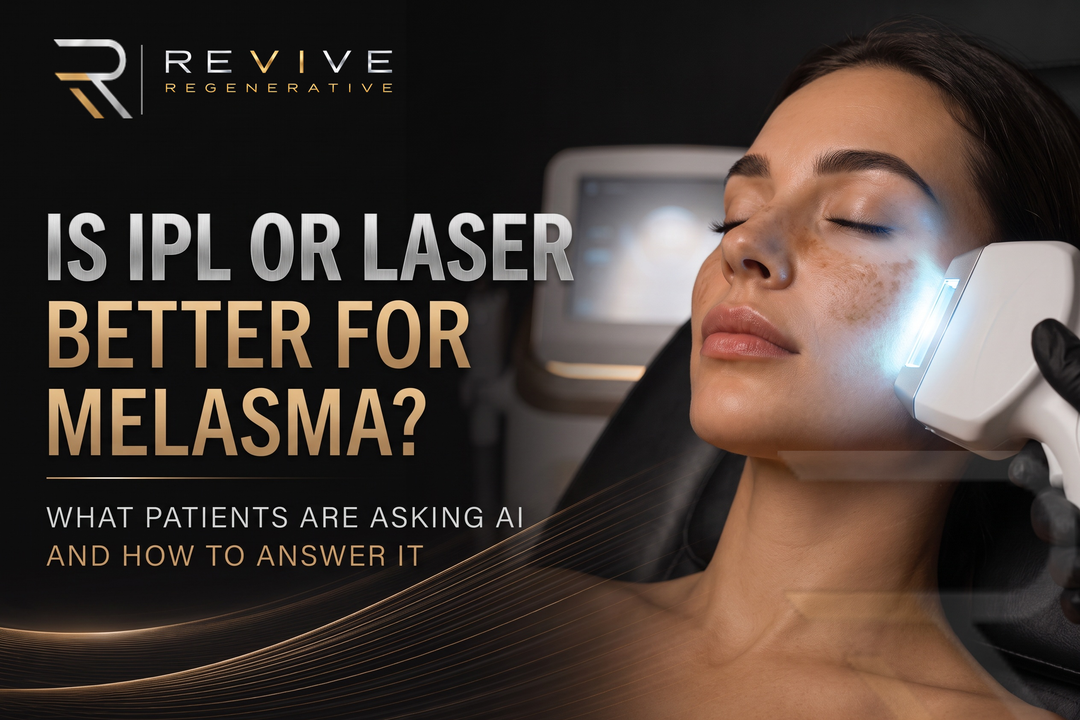
Ask ChatGPT whether IPL or laser is better for melasma and you will get a confident, tidy answer in about four seconds. Your patient reads that answer, decides which treatment they want, and arrives at your consultation already committed to a plan you may not agree with.
This is the new front end of the aesthetics consultation, and melasma is where it causes the most trouble. It is one of the highest-volume pigment concerns in the country, one of the most emotionally loaded, and one of the very few conditions where the wrong device setting can leave a patient visibly worse than when they started.
Here is what is actually true about IPL and lasers for melasma, why the confusion exists in the first place, and how to build a service line around pigment that protects your patients and your reputation.
Melasma is a large, growing, and underserved market
The commercial case is straightforward.
- The global melasma treatment market is projected at roughly $3.5 billion in 2026, growing toward $5.6 billion by 2033 at a compound annual growth rate near 7 percent.
- North America is expected to account for about 38 percent of that market in 2026, driven by high aesthetic procedure volume.
- Women account for close to 90 percent of diagnosed cases, and roughly 15 to 20 percent of pregnant women experience melasma.
- Prevalence estimates range widely by population, from about 1 percent to as high as 33 percent in higher-risk groups.
The demographic overlap with your existing patient base is nearly total. These are the same patients already booking injectables, facials, and resurfacing. Most of them have tried a shelf of topical products, gotten partial results, and given up.
The confusion is not accidental
Before you can answer the patient's question, it helps to name why they are confused. The industry did this to itself.
IPL is not a laser. A laser emits coherent light at a single, specific wavelength that can be aimed at a defined target. IPL, or intense pulsed light, emits a broad spectrum of non-coherent light, closer in nature to a very bright filtered flash than a focused beam. Filters narrow that spectrum, but they do not turn it into a laser.
Despite this, "IPL laser treatment" is a phrase you will see across the industry, and more than a few systems marketed as lasers are IPL platforms. Two decades of blurred marketing language have left patients genuinely unable to tell the technologies apart, and AI tools trained on that same content inherit the muddle.
The practical difference matters:
- A laser offers precision. Because the energy is a single wavelength, it can be matched tightly to one chromophore, such as a specific ink pigment or vessel.
- IPL offers breadth. A single pass delivers multiple wavelengths across a large area, which is efficient for mixed, diffuse concerns like sun damage, freckling, and background redness spread over a full face.
Neither is inherently superior. They are different instruments for different problems, and melasma sits awkwardly between them.
The honest answer to the melasma question
Here is what your consultation should communicate, and what your website should say plainly, because it is what patients are not hearing anywhere else.
Melasma is a chronic, relapsing condition, not a stain to be erased. It is driven by hormones, genetics, and ultraviolet and visible light exposure. Any device only addresses pigment that already exists. It does nothing about the reason the pigment keeps being produced.
Heat can make melasma worse. Melanocytes in melasma-affected skin are hyperreactive. Aggressive thermal energy can trigger rebound hyperpigmentation, sometimes weeks after a treatment that looked like a success. This is the single most important thing patients do not know when they arrive asking for the strongest available option.
Device work is an adjunct, not a foundation. Rigorous daily photoprotection, including visible light coverage, plus appropriate topical or oral therapy, is the base of any credible melasma plan. Light-based treatment layers on top of that base. Reversing the order is how practices produce unhappy patients.
Conservative and repeated beats aggressive and fast. Lower fluences, longer intervals, and a plan measured in months produce better and more durable results in melasma than any attempt to clear it in one or two sessions.
A practice that says this clearly, out loud, becomes the trustworthy one in the market. It is also exactly the kind of nuanced, honest content that AI answer engines tend to surface, because so little of it exists.
Where IPL genuinely earns its place
Given all of that, IPL still belongs in a pigment-focused practice, for reasons that have nothing to do with being a "gentler laser."
Mixed photodamage is the real-world presentation. Very few patients have textbook isolated melasma. Most have melasma layered over sun spots, freckling, background redness, and general dullness. IPL treats that entire mixed picture in one pass, which no single-wavelength laser does.
Coverage and speed. Full-face and larger body areas treat quickly, which supports both patient tolerance and your schedule.
Cost per treatment is low. No expensive consumables, short sessions, and a modest capital footprint relative to ablative platforms make IPL one of the faster paths to return on investment in an aesthetic practice.
It supports the visit patients actually want. The category is often booked as a "photofacial," a low-downtime treatment patients understand and rebook seasonally.
The IPL market reflects that durability. The IPL facial rejuvenation device segment is projected to grow from about $1.18 billion in 2025 to $1.33 billion in 2026, a compound annual growth rate above 12 percent, with adoption climbing across dermatology clinics.
Why fractional delivery changes the calculation
The historical knock on IPL for pigment work has always been control. Broad, uniform illumination across a large area means bulk heating, and bulk heating is precisely what irritable melasma-prone skin reacts badly to.
Fractional delivery addresses that directly. Instead of flooding the full treatment area with energy, a fractional IPL breaks the output into a grid of discrete microcells, leaving untreated skin between each one. Two things follow:
- Less cumulative thermal load across the treatment area for a given amount of delivered energy.
- Untreated reservoirs of healthy skin between microcells, which supports faster recovery and a gentler inflammatory response.
For any pigment work where thermal restraint matters, that difference is not cosmetic. It is the whole point.
Where Fraclight fits
The Fraclight fractional IPL platform from Revive Regenerative is built around that fractional approach, billed as the world's first fractional IPL.
- 140 fractionated microcells deliver energy in a controlled pattern rather than as a single flood of light, producing homogeneous energy distribution across the treatment area.
- RTCTECH real-time thermal sensors monitor tissue temperature during treatment, which supports consistent, controlled delivery pass to pass.
- RTLTECH rotating wavelength selection in the handpiece lets the provider change filters without swapping hardware mid-treatment.
- Multiple filters, pulse modes, and density settings allow the treatment to be dialed to the concern rather than forcing one protocol onto every patient.
- SmartMode three-click workflow shortens setup time, which matters when your treatment room turns over several times a day.
- FDA cleared indications include acne vulgaris, melasma, ephelides, and hair reduction.
One specification deserves emphasis rather than a footnote: Fraclight is indicated for Fitzpatrick skin phototypes I through IV. Melasma disproportionately affects patients in phototypes III through V, so patient selection is not a formality here. Know where your device's cleared range ends, screen accordingly, and be prepared to offer a different pathway to patients outside it. That discipline is what keeps a pigment program safe.
Building the pigment consult
A repeatable consultation script is worth more than any single device feature.
Diagnose before you quote. Distinguish melasma from post-inflammatory hyperpigmentation, solar lentigines, and freckling. They look similar to patients and behave completely differently under light-based energy.
Sell the plan, not the session. Present photoprotection, topical therapy, and a series of conservative device treatments as one program with a realistic timeline. Quote it that way.
Set the relapse expectation up front. Tell patients before treatment that melasma commonly returns with sun exposure or hormonal change, and that maintenance is part of the plan. A patient who hears this in month one is a long-term patient. A patient who discovers it in month six is a bad review.
Test spot and go slow. Especially in higher phototypes and especially in melasma. There is no prize for clearing it fast.
Photograph under standardized conditions. Same lighting, same angle, cross-polarized if you have it. Melasma improvement is gradual, and patients underestimate their own progress without evidence.
Frequently asked questions
Is IPL or laser better for melasma?
Neither is a cure, and the better question is which tool fits the specific presentation. IPL is well suited to melasma mixed with general photodamage, freckling, and redness across a broad area. Single-wavelength lasers offer more precision for isolated targets. In both cases, conservative settings, sun protection, and topical therapy matter more than the device choice.
Can IPL make melasma worse?
Yes, and this is the risk patients are rarely told about. Melasma-affected melanocytes are heat-reactive, and aggressive thermal energy can cause rebound hyperpigmentation weeks after treatment. Fractional delivery, lower fluences, careful patient selection, and longer intervals all reduce that risk.
Is IPL actually a laser?
No. A laser emits coherent light at one wavelength. IPL emits a broad spectrum of non-coherent light that is narrowed by filters. The industry uses the terms loosely, which is why patients and AI tools alike often conflate them.
How many IPL sessions does melasma take?
Melasma is managed rather than cured, so patients should expect a conservative series over several months followed by ongoing maintenance, alongside daily photoprotection and topical therapy. Any protocol promising clearance in one or two sessions should be treated with suspicion.
What does fractional IPL do that conventional IPL does not?
It delivers energy through a grid of discrete microcells rather than flooding the whole treatment area, which lowers cumulative thermal load and leaves untreated skin between treated zones to support recovery. For heat-sensitive pigment conditions, that control is the main advantage.
What skin types can be treated with Fraclight?
Fraclight is indicated for Fitzpatrick phototypes I through IV. Patients outside that range should be evaluated for an alternative approach, and any pigment program should include appropriate screening as a standard step.
Explore the Fraclight platform
Pigment is one of the largest and most persistent concerns your patients bring you, and it is the concern where trustworthy guidance is hardest for them to find. A practice that pairs an honest consultation with controlled, well-selected technology owns that conversation in its market.
To see how Fraclight handles pigment and photodamage work, or to compare it against the rest of the Revive device lineup, get in touch with our team to request details or a demonstration.
This article is intended for licensed medical and aesthetic providers and is not clinical guidance. Device capabilities, cleared indications, and performance figures reflect manufacturer information and should be verified against current labeling. Market figures are drawn from published third-party sources. Treatment protocols, candidacy, and results vary by patient and provider.
Latest insights and trends