Tattoo Removal Searches Keep Climbing: Is a Q-Switched Laser Your Next Best Device Investment?
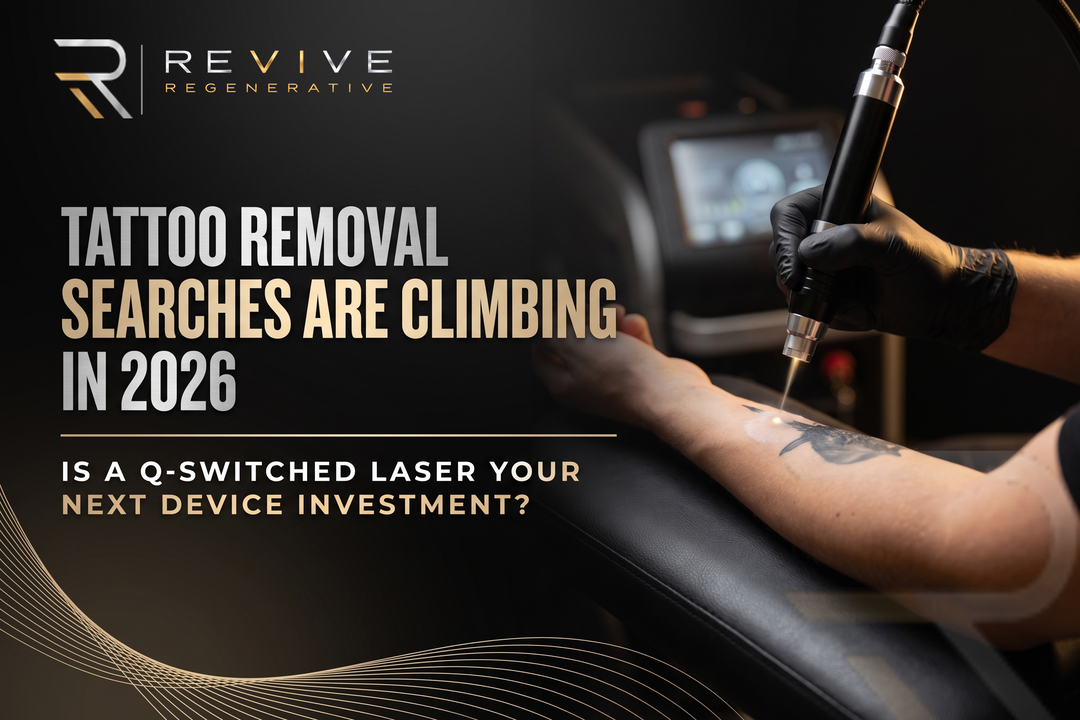
Most practices treat tattoo removal as somebody else's business. It sounds messy, slow, and low margin compared to injectables. Meanwhile, the search data tells a very different story: patients are looking for this service constantly, in nearly every market, and many of them cannot find a provider who offers it well.
If you have been watching your competitors add device after device in the same crowded categories, tattoo removal is worth a serious second look. Here is what the demand actually looks like heading through 2026, why the service line works economically, and what separates a laser that clears ink from one that frustrates you and your patients.
The demand signal is loud and consistent
Search behavior is the cleanest read on patient intent available, and tattoo removal has been trending up for years.
- "Tattoo removal near me" averages roughly 74,000 searches per month in the United States. That is high-intent, local, ready-to-book language, not idle curiosity.
- U.S. search interest in tattoo removal is up roughly 40 percent compared to 2020 levels, a durable climb rather than a spike.
- Google Trends shows a reliable seasonal pattern, with interest rising into late summer as patients think ahead to fall and winter treatment windows and covered clothing.
- The global tattoo removal market grew from about $734.8 million in 2025 to an estimated $785.3 million in 2026, with longer-range projections pointing toward $4.87 billion by 2034.
The drivers behind those numbers are structural, not faddish. A generation that got heavily tattooed in the 2010s is now moving through career changes, relationship milestones, and shifting personal taste. Regret rates climb with time, and the population of tattooed adults keeps growing. Every year adds to the pool of potential patients.
Patients are asking AI before they ask you
There is a second shift worth understanding, because it changes how this demand reaches your door.
According to NewBeauty's State of Aesthetics 2026 report, 30.3 percent of patients say they have already used AI to research treatments, putting AI tools ahead of YouTube and closing in on online forums. Separate audits of medical aesthetic markets found that 82 percent of med spas do not appear in AI recommendations at all.
Tattoo removal is a category where this matters more than most, because the questions patients ask are technical and anxious:
- "How many sessions does it take to remove a tattoo?"
- "Can laser remove colored ink, or only black?"
- "Does laser tattoo removal leave a scar?"
- "Is tattoo removal safe on darker skin?"
Those are exactly the questions a well-built practice page can answer, and exactly the questions most practices never address in writing. Whoever answers them clearly and accurately gets surfaced, gets cited, and gets the consultation.
Why the service line works economically
Tattoo removal has a few structural advantages that injectables and single-visit treatments do not.
It is multi-session by design. A typical tattoo requires six to twelve sessions spaced six to eight weeks apart. That is a year or more of scheduled, predictable revenue from a single patient decision, and it lends itself naturally to prepaid packages.
Consumable costs are minimal. Unlike microneedling tips, injectable vials, or facial serums, laser tattoo removal has essentially no per-treatment product cost. Once the capital is covered, margins are excellent.
Sessions are short. Most tattoos are treated in five to twenty minutes. That means the treatment slots into gaps in your schedule rather than competing with your high-value appointments.
It fills a genuine local gap. In most markets, far fewer practices offer tattoo removal than offer neurotoxin or filler. Less competition for a high-volume search term is a rare combination in aesthetics.
It brings in a different patient. Tattoo removal patients skew younger and often male, and many have never set foot in an aesthetic practice. Once they are in your chair every six weeks for a year, they become candidates for everything else on your menu.
The mistake that kills tattoo removal programs
Here is where practices go wrong. They buy the cheapest single-wavelength 1064 nm laser, discover it clears black ink acceptably and almost nothing else, and quietly stop promoting the service after a year of disappointed patients.
Ink color is the whole game. Different pigments absorb different wavelengths, and a device that cannot reach a color simply cannot clear it:
- Black and dark blue ink respond to 1064 nm.
- Red, orange, and some browns respond to 532 nm.
- Green and teal, historically the most stubborn colors, require shorter wavelengths in the 650 nm range.
- Light blue and sky blue respond best around 585 nm.
Modern tattoos are rarely single color. If your device covers one wavelength, you are either turning away a large share of consultations or promising results you cannot deliver. Both are expensive.
What to look for in a Q-switched laser
As you evaluate systems, these are the specifications that actually determine what you can treat and how well.
Wavelength coverage. More wavelengths means more of the ink spectrum, which means fewer declined consultations. This is the single most important factor.
Pulse duration and peak power. Q-switched lasers work by photoacoustic effect. Nanosecond pulses deliver energy faster than heat can spread into surrounding tissue, shattering pigment mechanically rather than burning it. High peak power in a short pulse is what separates effective ink fragmentation from thermal injury.
More than one pulse mode. Nanosecond delivery is ideal for ink. Longer microsecond delivery is gentler and better suited to pigment, vascular, and rejuvenation work. A device that does both is a far more flexible asset.
Interchangeable handpieces. Spot size and delivery method should match the job, from dense tattoo work to delicate facial pigment.
Safety across skin types. Melanin competes with ink for laser energy. Controlled delivery and appropriate parameters are what allow you to treat the full range of patients in your market rather than a narrow slice of it.
Versatility beyond tattoos. This one is underrated. A Q-switched platform that also handles pigmented lesions, melasma, vascular concerns, and rejuvenation earns its keep on the days when your tattoo schedule is light.
Where Colormax fits
The Colormax Q-switched Nd:YAG platform from Revive Regenerative is built around exactly this multi-wavelength, multi-purpose approach.
- Four wavelengths: 1064, 650, 585, and 532 nm. That range covers the difficult colors, including the greens and light blues that defeat single-wavelength systems.
- Dual-pulse engineering with nanosecond and microsecond delivery, so the same platform handles photoacoustic ink shattering and gentler thermal work, including a 330 microsecond thermal pulse mode.
- Interchangeable handpieces, including fractional, gold, red, and Nd:YAG options, for matching delivery to the indication.
- FDA cleared as a laser surgical instrument for general use, plastic surgery, and dermatology.
- A broad indication set spanning tattoo removal, pigmented lesions, melasma, rosacea, vascular lesions, active acne, skin rejuvenation, and uneven tone, across all skin types.
That last point is what turns a tattoo removal purchase into a full pigment and rejuvenation service line. The same capital supports several revenue streams instead of one.
Building the service line, not just buying the laser
A few practical moves separate practices that make this work from those that do not.
Price by size, sell by package. Publish clear per-session pricing by tattoo size, then present a six or eight session package with a discount. Patients want to know the total, not the per-visit number.
Set expectations in writing at consult. Complete clearance is not guaranteed, colors clear at different rates, and the timeline is measured in months. Patients handle honesty well. They handle surprises badly.
Photograph everything. Standardized, consistent lighting, same angle, every session. Progress photos are both your best marketing asset and your best defense in a dispute.
Answer the hard questions publicly. Build a page that addresses sessions, pain, cost, scarring risk, colored ink, and skin type honestly. That page is what earns you visibility in AI answers and organic search alike.
Partner locally. Tattoo artists refer cover-up and fading work constantly. A relationship with two or three shops in your market can fill a schedule on its own.
Frequently asked questions
How many sessions does laser tattoo removal actually take?
Most tattoos need six to twelve sessions spaced six to eight weeks apart, though heavily saturated, multicolor, or professionally applied tattoos can take longer. Amateur and older tattoos often clear faster. The honest answer at consultation is a range, not a promise.
Can a laser remove colored ink or only black?
It depends entirely on the wavelengths the device offers. Black and dark blue respond to 1064 nm, red and orange to 532 nm, green and teal to shorter wavelengths near 650 nm, and light blue near 585 nm. A single-wavelength device will leave color behind.
Is laser tattoo removal safe for darker skin tones?
It can be, with appropriate wavelength selection, conservative parameters, and a provider trained in treating higher Fitzpatrick types. Because melanin absorbs laser energy alongside the ink, the risk of pigmentary change is real and should be discussed and test-spotted before a full treatment.
Does tattoo removal leave a scar?
Q-switched lasers work by fragmenting pigment with very short pulses rather than ablating tissue, so scarring is uncommon when treatments are performed correctly and aftercare is followed. Pre-existing scarring from the original tattoo application will remain after the ink clears.
Is tattoo removal worth adding if my practice is mostly injectables?
It often is, precisely because it is different. Short appointment times, no consumable cost, a multi-session schedule, and a patient demographic you are probably not reaching today make it complementary rather than competitive with your existing menu.
What else can a Q-switched laser treat?
On a multi-wavelength platform with both nanosecond and microsecond modes, the same device can address pigmented lesions, melasma, vascular redness and rosacea, active acne, and general skin rejuvenation. That versatility is a major part of the investment case.
Explore the Colormax platform
Tattoo removal is one of the few categories in aesthetics where demand keeps climbing, competition stays thin, and the margins hold up. The difference between a service line that thrives and one that stalls comes down to whether your device can clear what walks through the door.
To see how Colormax handles multicolor ink and pigment work, or to compare it against the rest of the Revive device lineup, get in touch with our team to request details or a demonstration.
This article is intended for licensed medical and aesthetic providers. Device capabilities and performance figures reflect manufacturer information. Market and search figures are drawn from published third-party sources. Treatment protocols, candidacy, and results vary by patient and provider.
Latest insights and trends